Thursday, December 31, 2015

Venice

I had five days of easy me time in Venice. The whole city was beautiful, and I found Venetian history more and more interesting the more I learned about it.

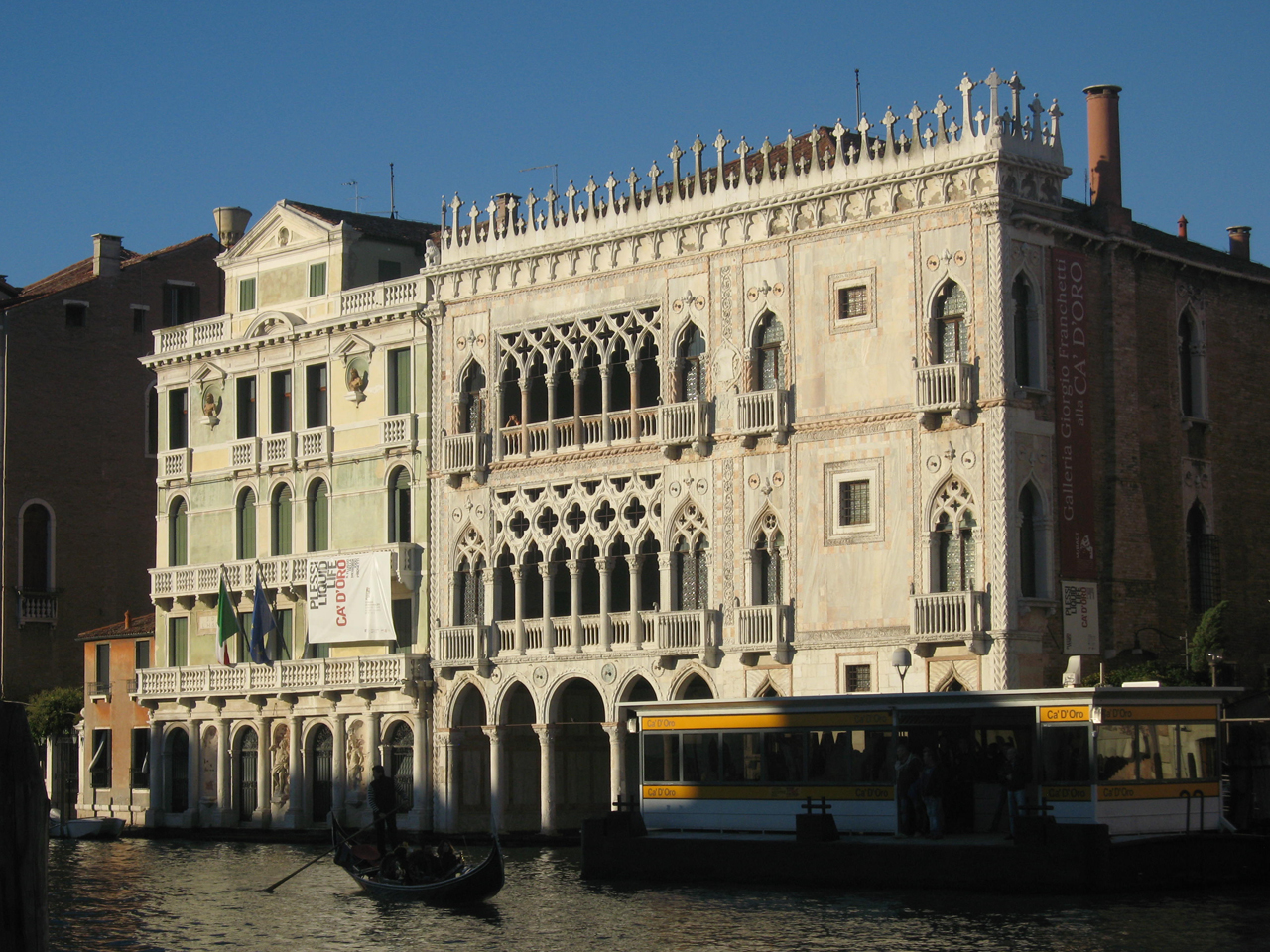
The heart of Venice is the Grand Canal, and you can get anywhere easily using the canal's vaporetti (water buses). Buildings with elaborate facades, many palatial houses, line the canal. Two of my favorites were the Ca'd'Oro ("House of Gold") and the Fondaco dei Turchi (a former Turkish trader warehouse, now the natural history museum).


The Piazza San Marco (Square of St. Mark) is Venice's main square, and the Doge's Palace, St. Mark's Basilica, and St. Mark's Campanile are there. My picture from the canal shows the Campanile on the left and the Doge’s Palace on the right.

The Doge was the Venetian Republic's elected leader, and the Doge's palace included government spaces. My picture below shows the ginormous Chamber of the Great Council. The Republic was also an early police state, and the palace has a "lion's mouth" postbox - a place to leave anonymous denunciations - and a prison.


A church was originally built on the site of St. Mark's Basilica in the 9th century to house the supposed remains of St. Mark, stolen from Alexandria. The present building dates from the 11th and 12th centuries, and the high altar now houses the supposed remains.

The basilica reflects Venice and Constantinople's linked history. Venice was originally part of the Byzantine empire, and the basilica’s five-domed design is Byzantine, executed by artists from Constantinople. Later in the 13th century, crusaders with Venetian ships and money sacked Constantinople, and loot was taken to the basilica, including relics and the Horses of Saint Mark.


Cameras aren't allowed inside the basilica, but I was able to sneak a grainy shot of the gilded interior after hours, through a grate in the door.

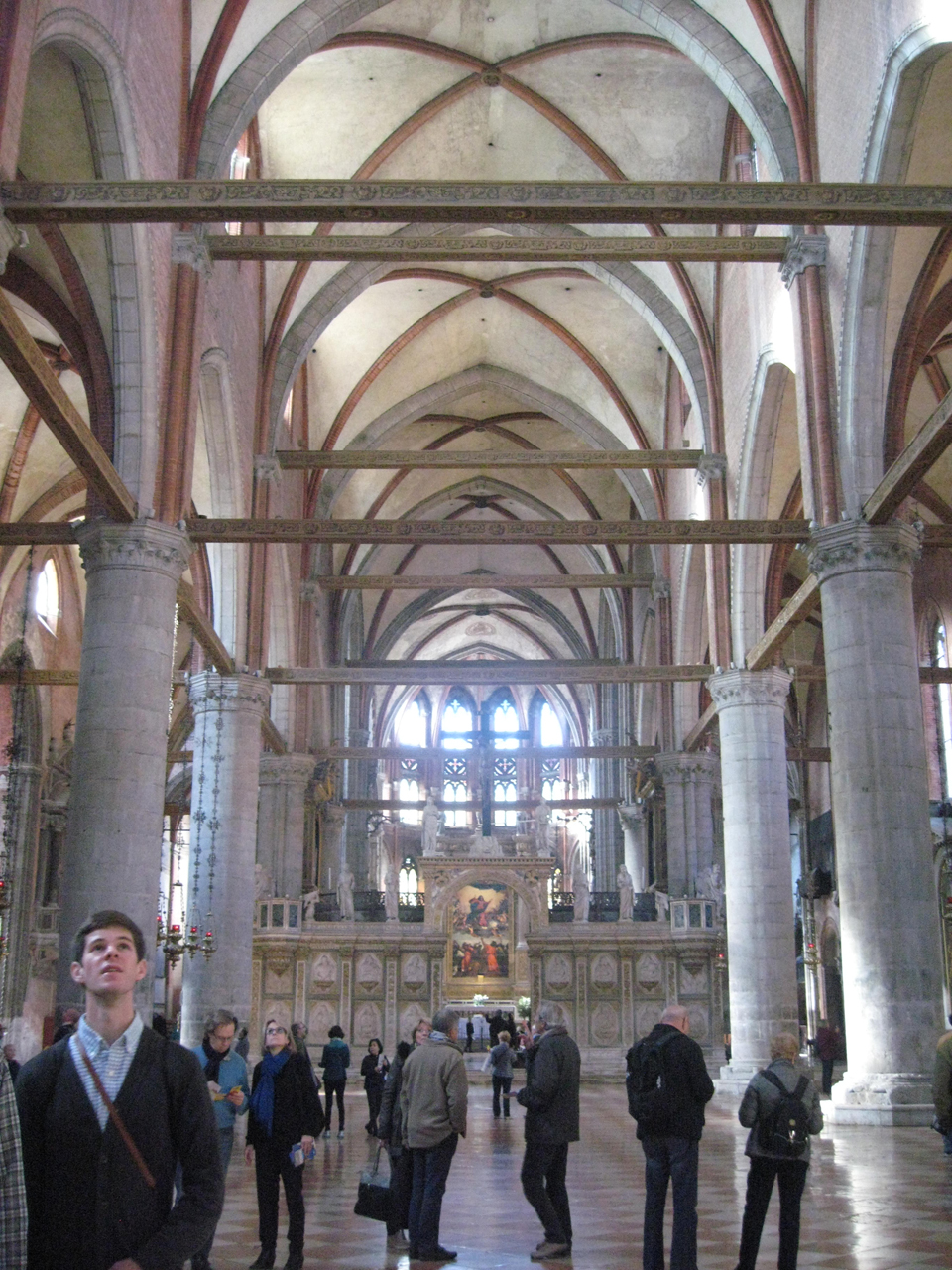
Besides the basilica, Venice also has two vast gothic churches, Santi Giovanni e Paolo (a.k.a. "San Zanipolo") and Santa Maria Gloriosa dei Frari (or just "the Frari"). San Zanipolo is from the 14th century and has many doges’ tombs. The Frari dates to the mid-15th century and has art by Titian and Bellini, and I was surprised to find Monteverdi’s tomb there. My picture is from inside the Frari.
I also took the vaporetto to visit the cathedral of Santa Maria and church of Santa Fosca on the island of Torcello near Venice. Santa Maria (left rear in my picture, including the tower) was founded in 639 A.D. Santa Fosca (right front) is a Byzantine church from the 11th and 12th centuries. It was simple and peaceful inside. On the way back to Venice, I was lucky to fall in with another tourist at the vaporetto stop and we spent the rest of the day exploring.

At its peak, Venice was the world’s great sea power. Its shipyard, the Arsenal, was practically a small city in itself, and could build a galley from start to finish in one day. Unfortunately the area is an Italian naval base now, so I couldn’t explore it, and my picture just shows the entrance. I sat down there to have some cookies from my bag, but a naval officer shooed me off.

Carnival masks have a long history in Venice.

Saturday, August 22, 2015

Lexington and Concord

I visited my friend Wei in Lexington, MA, and we visited some of the historic sites in Lexington and Concord.

In 1775, Britain considered Massachusetts to be in rebellion, and on the night of 1775 April 18, British troops marched out of Boston to seize a reported colonial arsenal in Concord. As they passed through Lexington around sunrise on the 19th, they found American militiamen assembled on Lexington Green, led by Captain John Parker. The British tried to disarm them, and in the rush and confusion, each side fired - the first shots of the American Revolution.

We visited Buckman Tavern, where Parker’s militia was before the British arrived, and Lexington Green nearby. The pictures are Captain Parker’s statue on the Green, and a monument marking one end of Captain Parker’s line.


Parker’s militia fell back, and the British continued to Concord. When the British arrived, Concord’s militia was assembled on a ridge outside of town, but marched toward town when they saw smoke rising from it. The encountered British forces holding the North Bridge and drove them off, killing several. The picture shows the reconstructed North Bridge.

Afterwards the British marched back toward Boston, harried by colonial fire the whole way. The American Siege of Boston, the "opening phase of the American Revolutionary War," started the same day.

We also visited Walden Pond, near Concord, where Henry David Thoreau famously spent two years living alone on a "voyage of spiritual discovery." The pictures show the lake, the site of Thoreau’s cabin, and a model of the cabin nearby.


We also visited Thoreau, Ralph Waldo Emerson, and Louisa May Alcott’s graves at Sleepy Hollow Cemetery nearby.

Gen Con 2015

I really enjoyed going to Gen Con 2014 with my old friend Rob and his friends, so I was excited to go again this year.

This year I was just there for two days and spent most of the time gaming. Here are Rob, Karen, Buck, and Lou playing, with one of our fantastic DMs, Gary. (Here's a 360 degree pano.) My lothario Warlock Aleister made it from level 2 to level 4, and his CHA went from 16 to 18, so he’s now +4 to sweet talking.

I did see some of the rest of the convention. Some Jedi were having it out, picture below, and I saw a surprisingly credible Daenerys Targaryen, but I wasn't quick enough to get the Khaleesi's picture.

I saw a few nerd-famous folks - Wil Wheaton was at my baggage claim. And, Mike Schley and Jared Blando signed their maps in my books.

Saturday, August 23, 2014

Gen Con 2014

I’ve been meaning to go to Gen Con for a long time, and this year I tagged along with my old college friend Rob and his gang, who've been going for years. We had a lot of fun.

This year they released the fifth edition of Dungeons and Dragons. Forgotten Realms legend Ed Greenwood signed my copy.


I also got a copy of Call of Cthulhu, one of the other classic RPGs, autographed by Sandy Peterson. He wasn’t actually signing stuff, but by crassly pestering many total strangers, I was able to track him down.

Rob and his friends got me into a day-long game of D&D even though I’d missed the sign up. Here’s the D&D play area, which was just one of many at the conference. Here is a 360-degree pano showing the same area.

Everyone knows that folks dress up for Gen Con, but I was surprised by how many costumes there were. There were about 50,000 people at the conference, and maybe one-tenth were in costumes. Here's Rob with Darth Vader.

Here’s Rob and Karen with (I think) the Winter Warlock. 2014.08.31: Correction: it's the Ice King from Adventure Time.

Gen Con was in Indianapolis, just a couple blocks from the Indiana state capitol.

Here's a detail from the Sailors and Soldiers Monument nearby. I'm not sure what those bears are doing!

Sunday, August 04, 2013

Chicago

I visited Chicago the weekend before July 4. I spent my time there walking around the Loop and whistling the Bob Newhart theme song.

Chicago is where the Chicago River meets Lake Michigan. In 1900 the river's direction was artificially reversed so that it wouldn't carry sewage into the lake.

Downtown Chicago is known as the Loop, for the elevated train loop that goes around downtown.

Chicago is known for its architecture and skyscrapers. The Monadnock Building was the tallest commercial building supported by its masonry walls rather than a steel skeleton.

The Reliance Building was the first skyscraper with a facade dominated by windows.

The Marquette Building was "...one of the early steel frame skyscrapers of its day, and is considered one of the best examples of the Chicago School of architecture....it is considered an architectural masterpiece."

Bas relief panels over the doors depict Jacques Marquette's exploration of the Great Lakes area.

A view of the Chicago skyline from Grant Park near the Lake Michigan. The Willis (Sears) Tower is the black building with antennas on the left.

American Gothic is at the Art Institute of Chicago.

Cloud Gate (or “The Bean”) and Crown Fountain are in Millenium Park at the north end of Grant Park.


The Chicago Picasso is in Daley Plaza, while Calder's Flamingo is a few blocks away in front of the Kluczynski Federal Building.


The world’s most complete T. Rex, Sue, is at the Field Museum.


Chicago's Blackhawks won the Stanley Cup a few days before I visited.

Kids posing in front of the Art Institute's lions, who are wearing Blackhawks helmets.

Saturday, October 20, 2012

Florence, Italy

Florence was the birthplace of the Renaissance. Renaissance greats like Michelangelo, Leonardo, Donatello, Botticelli, Galileo, Dante, and Machiavelli were born there, lived there, or worked there.

The Duomo (Basilica di Santa Maria del Fiore) is Florence’s main church. The Duomo was started in 1296 and finished with Brunelleschi’s dome in 1436. The white octagonal building left of the Duomo is the Florence Baptistery, built between 1059 and 1128.

Ghiberti's north doors for the Baptistery, finished around 1422, are considered the start of the Renaissance.


The gold-colored east doors were Ghiberti’s second commission for the Baptistery. Ghiberti considered the east doors his best work, and Michelangelo called them the "gates of paradise," which is still their name. The current east doors are a copy, with the originals nearby in the Duomo museum.


Florence's museums include Michelangelo's David, Donatello's David and Mary Magdalene, and Botticelli's Birth of Venus. This is Donatello's St. Mark at Orsanmichele.

Michelangelo, Galileo, and Machiavelli's remains are in Santa Croce, Florence's Franciscan church.

The Medici banking family ruled Florence. The dynasty’s founder, Cosimo, is shown in the Piazza della Signoria.

The Palazzo Vecchio -- Old Palace.

