Showing posts with label Retro Computing. Show all posts

Monday, April 21, 2025

Atari 2600

The Atari 2600 is the game console that made home video games a thing. 2027 will be the machine’s fiftieth anniversary, so it’s a good time to discuss it. I also know that some younger folks are laboring under the mistaken belief that the Nintendo Entertainment System was the first big game console, so this post is also for them.

Atari launched the 2600 in 1977 as the Video Computer System. Like the previous generation of home video games, like Atari’s own Pong, the 2600 displayed games on a CRT TV. Unlike the previous generation of games though, the 2600 played any number of different games on plug-in cartridges.

Here’s the 2600, my current one.


The machine sold for about $200 in 1977, or about $1,000 in 2025 dollars. It came with two joysticks, two rotating “paddle” controllers, and one game cartridge, Combat. Eight other games were available on launch, each costing about $30, or about $160 in 2025 dollars.

The 2600 wasn’t the first home game console, or the first one that played cartridges. But it was the first really successful one, and it established the home video game market that Nintendo, Sony, and Microsoft rule now. I wrote before that the Commodore 64 was the best-selling home computer of all time, selling 12 to 17 million. In comparison, Atari sold 30 million 2600s.

Atari

Nolan Bushnell and Ted Dabney founded Atari, Inc. in 1972. Bushnell also founded Chuck E. Cheese in 1977, partly as an outlet for Atari’s coin-op arcade games.

Atari started with coin-op arcade games. Their coin-op games included Pong and Breakout, which was prototyped by Steve Wozniak and Steve Jobs, who soon founded Apple. Some of the games like Asteroids and Tempest used vector graphics, and a few later ones were even 3D wireframe games like Star Wars.

Atari moved into home video games with a home version of Pong in 1975, but single-game machines were expensive to develop and didn’t sell long. In contrast the Fairchild Channel F, introduced in late 1976, could play different games on ROM cartridges. Atari’s subsidiary Cyan Engineering created the 2600, which similarly played cartridges, with a little help from folks who’d contributed to the Channel F.

Bushnell needed capital to launch the machine, and he sold Atari to Warner Communications and stayed on as Atari’s chairman and CEO. However, Warner also brought in Ray Kasskar from Burlington Industries to help with Atari’s products. In a turn reminiscent of John Scully firing Steve Jobs from Apple, Kasskar fired Bushnell and took over as chairman and CEO. Bushell bought Chuck E. Cheese from Atari as he exited.

The 2600 sold well initially, but sales exploded when Space Invaders arrived on the machine in 1980. Wikipedia says that 1.25 million copies of the game were sold in 1980 alone, and that console sales quadrupled.

In 1979 Atari also introduced home computers, the 400 and 800, and sold around 2 million of them. In 1982, Atari introduced the 5200 game console, based on the 400/800 architecture. But the 5200 didn’t run 2600 games and didn’t match its success.

Then in 1983, the video game market crashed. Wikipedia reports that the “home video game revenue peaked at around $3.2 billion in 1983, then fell to around $100 million by 1985 (a drop of almost 97 percent).” Two notoriously bad 2600 games - Pac-Man and E.T. the Extra Terrestrial - are often implicated in the crash.

Atari lost hundreds of millions of dollars, and Warner partnered with Namco to reorganize Atari’s coin-op business as Atari Games Corporation. This was the Atari that made Gauntlet and the arcade version of Tetris. Namco soon sold its stake though, and different owners passed the company around until the end in 2003.

Warner sold Atari’s other businesses - home video games and home computers - to former Commodore chairman Jack Tramiel, who formed Atari Corporation. Tramiel’s Atari soon launched the Atari ST, a home computer with a Motorola 68000 CPU, to compete with the original Apple Macintosh and the Commodore Amiga.

Tramiel’s company also released new game consoles after the crash, the Atari 7800 and the Jaguar, but the Nintendo Entertainment System (1985) and later the Sony Playstation (1994) captured the home market. In 1996 Atari Corporation was sold to JTS Corporation, then Hasbro, and basically became a brand name that licensed Atari’s classic IP.

the 2600

The 2600 had 128 bytes of RAM and a MOS 6507 CPU, a cheaper version of the 6502 common in 8-bit computers. Game cartridges had up to 4K of ROM, or more with bank switching. The 2600 didn’t have an operating system - when you turned the machine on, it started executing the instructions on the cartridge ROM.

The 2600 had a custom graphics and sound chip, the Television Interface Adapter (TIA). Unlike other computers, the 2600 didn’t have enough RAM to represent the 2D display internally. Instead, programs drew each line of the display individually as the CRT’s electron gun swept across and down the screen. This was done by setting registers in the TIA, and the program’s instructions had to be carefully synchronized with the electron gun.

For sound, Wikipedia says that the TIA “is not a musical chip” and only provides “detuned notes and the odd tuned frequency.” Some games do have music though, and the machine plays electrifying sound effects.

Atari’s Jay Miner designed the TIA, and later the custom chips for the Atari 400/800 and the Commodore Amiga. The book “Racing the Beam” discusses the 2600’s hardware using case studies of six games, and discusses the TIA in detail.

A modern game controller is cluttered with controls - a joystick, a directional pad, the main buttons, trigger and bumper buttons, a menu button, a rumble motor. The 2600’s controller had a joystick and a button. The joystick connected to the console through a nine-pin port that could accept paddles or a trackball instead, and the port became a standard on other home computers and game consoles of the era.

Antenna terminals were the only input on many televisions in 1977, and you connected the 2600 to your TV through an RF modulator box that screwed onto the terminals. Getting around to the back of your TV and screwing on the little box was a part of the 2600 experience. The picture could be staticky though, and nowadays a lot of old 2600s are modified to send composite video to the TV’s RCA jacks, which produces a nice picture.

games

Atari and third-party developers made hundreds of games for the 2600. Atari alumni formed Activision and Imagic, and Activision was the most successful third-party developer. But many others joined in, including the toy companies Coleco, Parker Brothers, and Mattel.

The most typical 2600 games were coin-op conversions - clear levels by shooting aliens or whatever until you die three times. Space Invaders, Pac-Man, Donkey Kong, Frogger, and many others fit this mold. Some games did buck the trend though. Adventure, for instance, started as an effort to adapt the mainframe text adventure Colossal Cave Adventure to the 2600, a machine highly unsuited to it.

What were the best games? Atari Age has a long-running thread, Top 100 2600 games of all time, and some good souls on the thread tabulate the games mentioned there. The most recent update I can find gives the top 10 as:

  1. Pitfall!
  2. Pitfall II: Lost Caverns
  3. Adventure
  4. River Raid
  5. Missile Command
  6. H.E.R.O.
  7. Yars’ Revenge
  8. Space Invaders
  9. Asteroids
  10. Ms. Pac-Man

Six of the games are Atari cartridges, and four are Activision, including the top two.

Wikipedia lists the best-selling 2600 games. The top 10 are:

  1. Pac-Man
  2. Space Invaders
  3. Donkey Kong
  4. Pitfall!
  5. Frogger
  6. Asteroids
  7. Defender
  8. E.T. - the Extra-Terrestrial
  9. Ms. Pac-Man
  10. Demon Attack

The list makes sense - Demon Attack is the only one that surprised me. Most are coin-op hits, and the video game crash games Pac-Man and E.T. are there.

my experience with the 2600

I had the all-black “Vader” 2600, from 1982, and I played hundreds of hours on it. By then toy stores sold bargain bin cartridges for a few dollars each, and over time I picked up thirty games or so. In those days every other house with kids also had a 2600 and a pile of games, and you also could share games easily.

What games stick with me after forty years? Atari’s space shooters were staples - Space Invaders, Asteroids, and Missile Command. Chopper Command, Atlantis, and Star Trek were also favorites.

But I think the best game was Montezuma’s Revenge, an Indiana-Jones-type adventure like Pitfall, but less repetitive, faster moving, more cheerful. The cartridge is hard to find used nowadays, but you can play it in your browser at atarionline.org. If you just look at the first screen, you can already get a feel for much more fun than Pitfall it is.

The first 2600 game, Combat, still stands out for me because it’s a two-player game, and dueling your friends can still be a riot despite the game’s simple graphics. The “tank pong” variations are the ones to try. Combat is also interesting because the 2600 and Combat were developed together, and Combat’s requirements guided much of the 2600 hardware design.

One game, Mountain King, has stuck with me because it’s weird. Your stick-figure explorer runs around inside a mountain looking for the Flame Spirit and Golden Crown he needs to escape. You can jump in an arc, and if you jump again as you land, you’ll go into a higher arc. If you rejump high enough, you’ll reach a weird area above the mountain that changes unpredictably as you move around it, “glitch heaven.” This thread discusses whether glitch heaven is an intentional part of the game, but I always thought it was an obvious programming error, like the RAM’s contents being rendered as the mountain.

What about the crash games, Pac-Man and E.T.? Pac-Man’s gameplay is fun independent of how it looks, and anyway it doesn’t look any worse than Space Invaders, which was the 2600’s killer app just a few years before. On the other hand, I found E.T. incomprehensible, but in fairness I never read the manual.

Although the 2600’s sound looks modest on paper, I think it had great sound effects: your helicopter’s rotor blades in Chopper Command, the alarming drone of Gorgon deathrays blowing up Atlantis, and the squish of Panama Joe falling to his death in Montezuma’s Revenge.

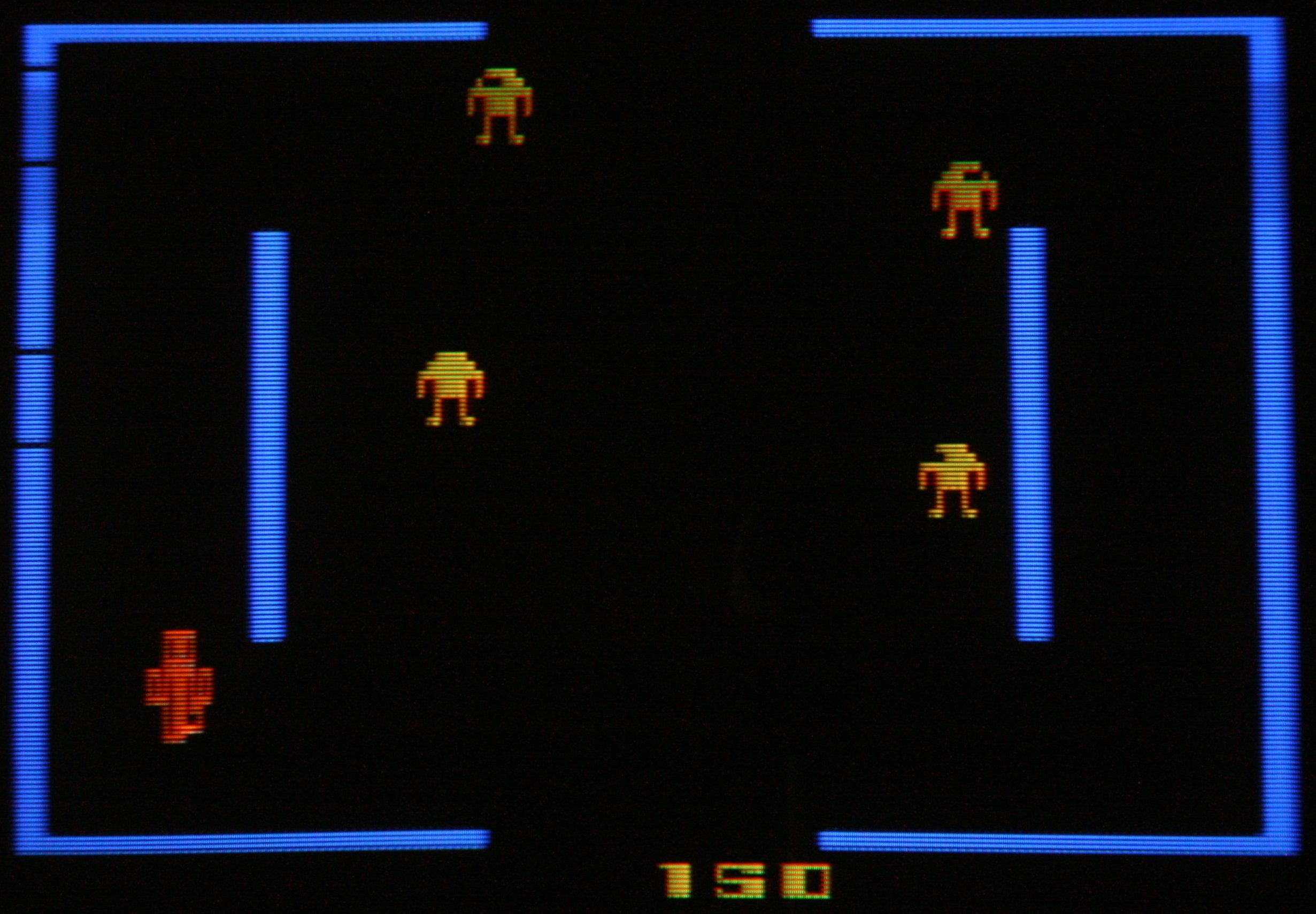
The sizzle when you’re electrocuted in Berzerk is my favorite though.
I wrote that the 2600 isn’t a music machine, but games did have music. For instance, Frogger plays a full theme before you jump into traffic. Mountain King sometimes plays “In the Halls of the Mountain King,” raising or lowering the volume depending on how close you are to the Flame Spirit.

playing the 2600 in 2025

These days it’s easy to play 2600 games in your browser, or by downloading an emulator and some game ROMs.

If you want to experience the actual hardware, and play with the classic 2600 joystick, consoles sell on eBay for $50 to $350 as I write this. Often they come with a pile of games. Some have the composite video mod, which I’d recommend over the RF modulator unless you’re hell-bent on the most authentic 1977 experience.

Sunday, September 15, 2024

Commodore 64, Pool of Radiance

I picked up a couple of Commodore 64s and I’ve been test driving them with Pool of Radiance, the classic AD&D CRPG. The Commodore 64 and Pool of Radiance are both new to me.

The Commodore 64

The Commodore 64, introduced in 1982, was an 8-bit computer like the Apple II and Atari 400/800. The machine was a giant of the home computer era: Wikipedia says “between 12.5 and 17 million” were sold, that it’s the best selling computer of all time, and that it had a massive software library of almost 10,000 titles.

The 64 had a MOS 6510 CPU, a variant of the same 6502 that Apples and Ataris had, running at about 1 MHz. For perspective, a modern 2024 CPU runs at 3,000 times that clock speed or more, and does more each clock cycle than the 6510. The Commodore 64 had 64 kilobytes of RAM, thus the name, whereas a PC in 2024 can have 1,000,000 times that.

The 64 also had custom graphics and sound chips, the VIC II and SID, which were “instrumental in making the C64 the best-selling home computer in history.” The VIC II supported screen resolutions like 320x200 and 160x200, and up to 16 colors. Again for comparison, a modern GPU in 2024 supports 4k resolution with full color, but also supports 3D rendering and can do substantial parallel computing beyond just graphics.

Commodore sold the 64 from 1982 until the company went bankrupt in 1994. The first model, the “bread bin,” looked very similar to Commodore’s previous computer, the VIC-20. A more streamlined “64C” model was introduced in 1986.

The 8-Bit Guy has a series of videos about Commodore’s machines including the 64, focusing on tech. Commodore’s business history is also interesting. For instance, Commodore’s home computer price war in the early 80s drove Texas Instruments out of the market. Jack Tramail was Commodore’s chairman, and his move to rival Atari set up the competition between the Commodore Amiga and the Atari ST in the 16-bit era.

Commodore 1541 floppy drive, floppy emulators

The 64’s floppy disk drive, the Commodore 1541, is notable in its own right, or at least notorious. It was slow, 8 times slower than Atari’s drive and 50 times slower than Apple’s. IEEE Spectrum said “the one major flaw of the C-64 is not in the machine itself, but in its disk drive.”

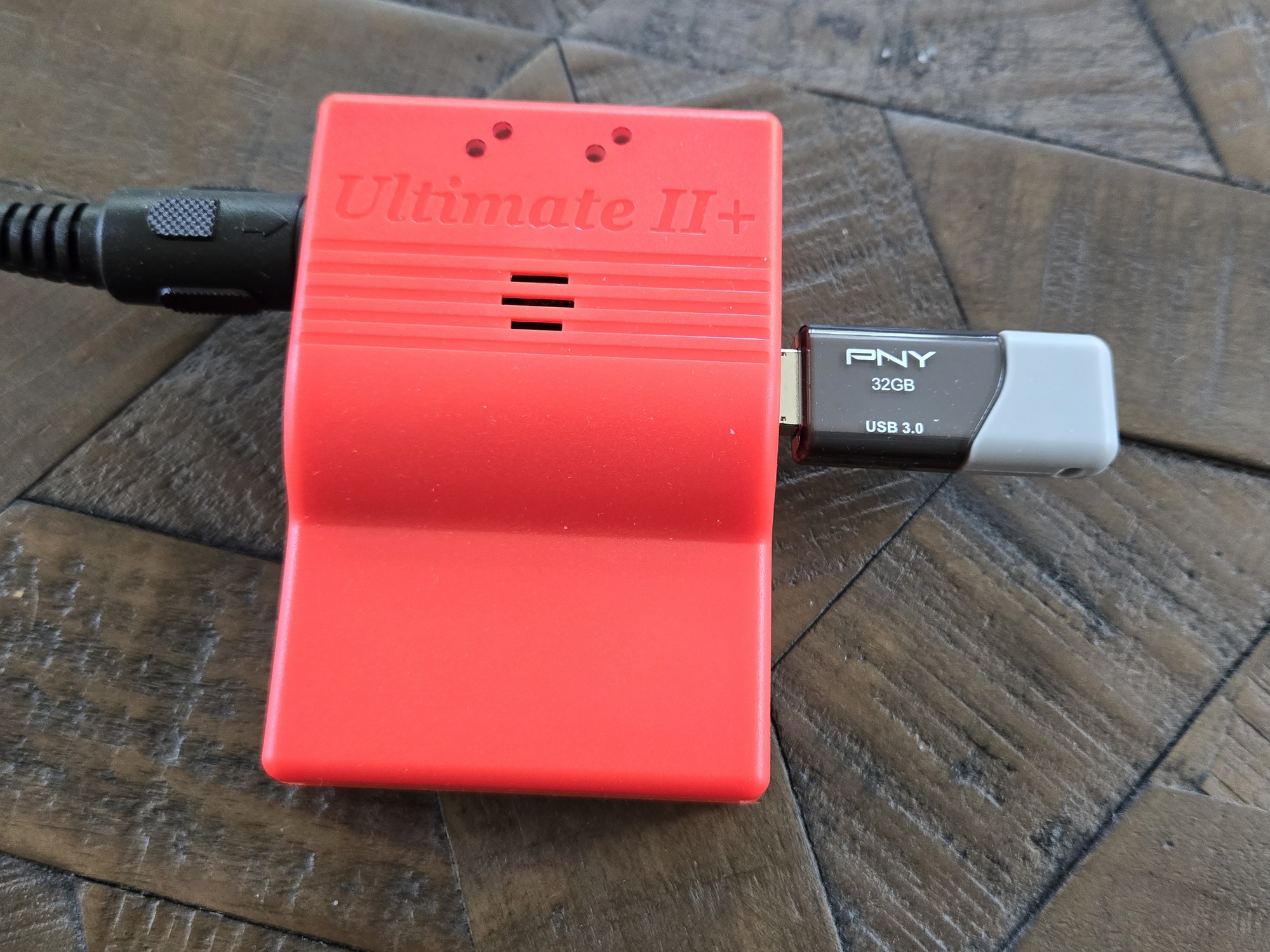
Working floppy drives are getting hard to find, but you can use a floppy drive emulator instead, which looks like a floppy drive to the 64 but uses modern storage. I’m using the Ultimate-II+L, which uses USB sticks for storage.

My setup

I picked up two Commodore 64s from eBay. The first is a nicely refurbished bread bin, but went on the fritz after about a week. The second is the streamlined 64C model, which is working well.


I also picked up two 1541 floppy drives from eBay. Neither worked for me at first. The web suggested that formatting a blank disk with them might reset them and make them work again. That actually did make one of my drives work, but it went bad again after about a week.


After that I switched to the Ultimate-II+L floppy emulator, which works well. Of course the emulator can’t read from real floppies, so you’re limited to disk images from the web. But one advantage is that you can easily create as many virtual floppies on your USB key as you want. For Pool of Radiance, that’s been handy for making a new save disk for each save.


My kind neighbors lent me their nice CRT TV to use as a display, which has also been great for other retro machines like the Atari 2600, TI-99/4A, GameCube, etc.


Pool of Radiance

Pool of Radiance is a CRPG published by Strategic Simulations Inc. (SSI) in 1988. Matt Barton called it “...one of the greatest role playing games of all time and probably about the most fun you could have with a Commodore 64 in 1988,” and the CRPG Addict similarly wrote, “Pool of Radiance is the best game I've played since starting this blog.” Pool of Radiance spawned SSI’s series of “gold box” games, which together sold 800,000 copies.

Although many - probably all - previous CRPGs descended from Dungeons and Dragons, Pool of Radiance was the first to use the actual AD&D rules. The game has a long campaign-style story written by TSR, the original D&D folks, set in the Forgotten Realms.

In a little more detail, the player’s party has to clear the small town of New Phlan of the monsters plaguing it, while they slowly learn about the “Boss” driving them. The map of Phlan and its surroundings from the game’s journal booklet, and the map of the slums from the hint book, give an idea of the scale of the game.


The game

Here’s the physical game. The game comes on four double-sided disks, and you have to swap disks frequently while playing.


The game comes with a decoder wheel, for the copy protection scheme, but the wheel is also used to translate a few clues during the actual game.


To load the game, you use the the classic Commodore 64 incantation ‘LOAD”*”,8’, which loads the first program (*) on the first drive (8).


After loading, you’re treated to a splash screen and music, and a credits screen.


The TSR authors listed there are TSR original gangsters. For instance, David “Zeb” Cook wrote the D&D Expert Set, AD&D 2e, and the Planescape setting.

I’d summarize the gameplay as three parts. The first is navigating New Phlan and its surroundings in the 3D view, which I think is most similar to The Bard’s Tale (which I haven’t played). Many of the 3D views look like cubicle farms to me, but locations can have interesting textures and colors, like New Phlan’s city hall and dock, or Mendor’s library.


When you run into trouble in the 3D view, you’re briefly treated to a Monster-Manual-like portrait of the monster. Here are a few portraits - goblins, orcs, and a basilisk.


From there you go into the second part of the game, combat, shown in a top-down view. Here are some shots of the top-down combat in the two most notorious early-game fights, the trolls in the slums, and the Boss’s mob in Sokal Keep.


The third part is logistics, done with text menus: leveling up your characters, buying and selling equipment, resting, memorizing spells, etc. Some tasks, like redividing money between the party members, take a little investigation and trial-and-error to learn, but you soon develop the rituals and muscle memory for them. Overall though, using the text menus is like doing 80’s style data entry.

My experience with the game

I’ve claimed the rewards for the first few areas of the game - the slums, Sokal Keep, Kuto’s Well, Podol Plaza, the Cadorna Textile House, and Mendor’s Library - and my characters are between 3rd and 5th level. Judging from the hint book, I’ve finished about one-fourth of the game. I’ve become pretty fluent with the game: combat and spellcasting; the cycle of combat, healing, re-memorizing spells, and resting; leveling; managing the party’s money; all that kind of stuff.

Is the game “one of the greatest roleplaying games of all time,” for me? No, at least not so far. The first big part of the game is clearing the slums, a joyless grind full of random encounters. The other areas after the slums are more fun - quicker areas with unique encounters and leads about the game’s larger story. So, maybe it’ll be more fun going forward.

For graphics, the monster portraits are nice, but the 3D views and top-down combat screens are downright ugly. For sound, the sound effects and even the splash screen music are charmless.

I couldn’t stop thinking about two other games while I played. The first is Dungeon Master, which I haven’t played yet. Dungeon Master was a CRPG for the Atari ST that came out six months before Pool of Radiance. The game is a colorful first-person dungeon crawl, and at least visually, it’s the game for 1988, the 16-bit era. SSI seemed to think so too - they soon responded with Eye of the Beholder, a Dungeon-Master-like game using the AD&D rules.

The other is the original Baldur’s Gate, which came out for PC in 1998, ten years after Pool of Radiance. Baldur’s Gate is also a CRPG using the (second edition) AD&D rules, and mostly takes place in a top-down isometric view like the combat in Pool of Radiance. That’s where the similarities end though. Baldur’s Gate has beautiful graphics and sound, like the pre-rendered isometric scenes, spell animations, and voice acting. Combat is “real-time with pause,” which plays out in real time unless you pause it to issue new instructions to the characters. And unlike Pool of Radiance, the game’s detective story is actually about your characters, and the game can be laugh-out-loud funny.

Incidentally, I notice that while Matt Barton called Pool of Radiance “one of the greatest roleplaying games of all time,” he actually called Baldur’s Gate “the greatest computer roleplaying game of all time.” Even in the 2020’s, a lot of new games are directly modeled on Baldur’s Gate, and Baldur’s Gate still routinely appears on lists of the best CRPG’s of all time.

AD&D

One reason I picked Pool of Radiance to try the Commodore 64 was to learn some first-edition AD&D. I never played AD&D when it was current, from 1977-1989.

Here are the AD&D hardcovers, 1977-1979, all by Gary Gygax.


I have played a little of AD&D’s simpler siblings, Tom Moldvay’s D&D Basic Set and David Cook D&D Expert Set, both from 1981. Those games share some strange features with AD&D. For instance, you get most of your experience points from finding treasure. That’s straight-up weird, and Gygax actually concedes in the Players Handbook, “Gaining experience points through the acquisition of gold pieces and slaying monsters might be questioned by some individuals as non-representative of how an actual character would become more able in his or her class.”

Other strange things in AD&D include “lower armor class is better” and arbitrary restrictions on the maximum level that different races can reach in different classes. For instance, halflings can only be fighters, thieves, or fighter/thieves, and can only reach 6th level as fighters. AD&D has multiclassing, but you have to multiclass your character when you create it. In contrast, In modern D&D you can multiclass over time by choosing a class for each level. For instance, a fifth-level fighter who levels up and adds a level of rogue would get the class features of a fifth-level fighter and a first-level rogue.

If you know the modern edition of AD&D though, D&D 5e, many things about AD&D are very familiar. Many of the go-to spells in 5e are already present in AD&D - Magic Missile, Detect Magic, Bless, and many others. Sleep is already your go-to for shutting down hordes of low-level enemies. As with 5e, clerics and magic users get new spells every other class level - 1st level spells at class level 1, 2nd level spells at class level 3, etc.

What about combat? I’m really not sure at this point. I thought while I was playing Pool of Radiance that the tactical combat was very similar to (a subset of) 5e combat, and that I was mostly seeing the D&D combat I knew - roll initiative, move, attack, cast, maybe bandage/stabilize a downed ally. But, I’ve been surprised by how unhelpful the AD&D Players Handbook and Dungeon Masters Guide are on combat, so still more to learn there.

Sunday, March 24, 2019

Heroes of Might and Magic III

March 2019 was the twentieth anniversary of Heroes of Might and Magic III, the legendary turn-based strategy game.

In the game, your heroes and their armies ride out from your towns to explore the Adventure Map, find loads of bling, and conquer other heroes and towns. Meanwhile, you grow the towns that support them. Your exact goal depends on the scenario, but I like the ones where you have to beat all the enemy heroes and towns - total victory.

Here’s a shot of the adventure map, with Red’s hero landing his ship near Purple’s inferno town.  Some adventure maps have subterranean levels, shown in the second picture.


For heroes, you start with one or two and recruit others at your towns' taverns. Heroes have four primary skills - Attack and Defense help their army fight and Power and Knowledge make their spells more powerful - and they have some secondary skills like Leadership, Luck, and Wisdom. Leveling up by winning battles and finding treasure chests improves your primary skills and gives you new secondary skills. Artifacts also often improve your primary skills - sometimes spectacularly - and they can be found on the adventure map or taken from beaten heroes.

Your heroes travel with an army of up to seven stacks of fantasy creatures, where each stack contains one kind of creature. Each creature type has a level from 1 to 7; the higher level creatures are stronger and more expensive, but towns produce fewer of them. So for example, you might have a hero with a hundred level 1 creatures and only three or four level 7 creatures.

The Hero Screen shows your heroes and their skills, artifacts, creatures, and war machines (catapults, for example). The picture shows the hero screen for a high-level hero. She has a very strong necropolis army shown along the bottom - 20 ghost dragons, 73 dread knights, and 131 vampire lords are a ton. She’s also flush with artifacts, shown on the paper doll - about 10 (!) of them were just captured from another hero.


For towns, you start with one or two and capture others from your opponents. On the biggest maps you’ll eventually have to capture about twenty towns to win. You upgrade your towns with new buildings when you can afford them, up to one per town per day. Example buildings include creature dwellings, which supply your armies with creatures each week; town halls or city halls, which give you gold each day; and citadels or castles, which improve your town’s defenses and creature growth.

There are eight town types in the base game - castle, dungeon, fortress, inferno, necropolis, rampart, stronghold, and tower - and each has unique creature dwellings. For example, castle towns produce pikemen (level 1) through angels (level 7), and dungeon towns provide troglodytes (level 1) through red dragons (level 7). Each dwelling can also be upgraded once to grow stronger creatures. For example, the castle’s Portal of Glory angel dwelling can be upgraded to make archangels.

The Town Screen shows your towns’ buildings. The pictures show the town screens for a castle town and tower town with all the improvements finished.


If a hero attacks another hero, a town, or creatures on the adventure map, they fight on the Combat Screen. You can direct the fight or watch the computer do it. I usually watch, and I think the computer is better at using the hero’s spells than I am. I’ll direct it myself sometimes - if I want to conserve my hero’s spell points for another battle, lure the enemy outside of their castle walls, hide inside my walls while arrow towers pick off the enemy, or avoid damage from moat defenses.

The two pictures show a combat screen for two heroes meeting in the field and for two heroes' ships meeting.


This picture shows Blue attacking Red's stronghold town. The town has a castle, which provides the walls and the three defense towers with orcs in them.

STRATEGY

Start strong. For heroes, recruit three or four additional heroes on days one and two, and they’ll more than pay for themselves right away by vacuuming up the treasure and resources near your starting towns. Move all the modest creatures from your starting heroes to one hero on day one, and buy any low-level creatures already available in the town, then capture the sawmill and ore pit nearby. If you can, use that hero to capture the nearest enemy town in week one, to double your early strength and sideline one of your enemies. Since your heroes can only have seven creature stacks, bias toward capturing towns of the same type you already have, to produce more of the same seven creatures.

For town improvements, build your town hall, city hall, and capitol ASAP to generate revenue for buying more buildings and creatures. Building a capitol requires building a castle first, which doubles your creature growth; further maximize creature growth by building all seven of your creature dwellings ASAP. Later in the game, when you have several towns, make sure each has the castle and seven creature dwellings. You’ll be surprised how many creatures they accumulate while you’re busy with other things, and the accumulated creatures provide an instant defense to buy if the town is threatened. Each creature dwelling can be upgraded, but existing creatures can be upgraded after their dwelling, so you don’t need to upgrade dwellings until it’s convenient.

Don’t be shy about continually saving and reloading. Save your game right away on day 1, play a few weeks to learn the lay of the land around your towns, then reload and start your real game again from day 1. Save before each battle, and reload and retry close battles you lose.

Maps range from Small to Extra Large, depending on the scenario. I like Extra Large maps and I usually need more than a full day to finish one. To win big maps, your best hero will eventually need the Town Portal spell, which lets you teleport to any of your towns and kill enemy heroes that have strayed too close. Otherwise, without Town Portal, your small number of strong heroes will never be able to defend all your towns or track down all of your opponents' heroes.

For each scenario, you can choose from five difficulties, from Easy (80% rating) to Impossible (200% rating). I always choose Expert (160% rating), which is hard enough that I have to systematically save and reload, but winnable. I tried Impossible in the distant past and really did find it to be unbeatable.

EXPANSIONS AND SEQUELS

Heroes III had two official expansions: Armageddon’s Blade, which added the elemental-themed Conflux town shown below, and The Shadow of Death, which added new campaigns. Heroes III Complete combined both expansions with the base game; it came out in 2000 and is on GOG.com now.

Horn of the Abyss is a free, unofficial expansion that adds new elements like the pirate-themed Cove town shown below, and a Factory town is in progress. The art is as pretty as the original game art. Amazingly, it adds Huge, Extra Huge, and Giant maps beyond the base game’s Extra Large maps. It installs happily on top of GOG’s Heroes III Complete.

Heroes III was followed by Heroes IV through Heroes VII, which all used 3D rendering instead of 2D art like Heroes III. It’s a cliche to ding them for not being Heroes III, but they have good reviews. For instance, Gamespot gave III a 9.2, IV an 8.8, V an 8.2, and VI an 8. I played Heroes IV and Heroes VI a little around the times they came out and I liked them.

For similar games, Disciples: Sacred Lands and Age of Wonders came out in 1999, the same year as Heroes III. 50 Games Like Heroes Of Might And Magic 3: Complete includes more suggestions.

Friday, July 01, 2016

Apple II, Wizardry

I mentioned in an earlier post that the Atari 2600, the Apple II, and TI-99/4A are what got me into computers in the 80’s. Of those three, the Apple II had the biggest impact by far, and I did most of my programming on the Apple II until switching to an Atari 520ST in 1986 or so. Over the last few years I’ve had a couple of Apple II’s in my closet waiting for me to clear my schedule, and I’ve been able to dust them off in the last few weeks and fire up the original Wizardry, which I never played in the day.

I think it’s safe to say the Apple II was the granddaddy of the home computer era, the late 70’s and 80’s, before the personal computer market narrowed to Windows PC’s and the Macintosh. Apple launched the Apple II as its first product in 1977 and manufactured them until the IIe ceased production in 1993, long after they were technically obsolete. In contrast to the Commodore 64, the other monster seller of the time, the Apple II was pervasive in schools, which was a major reason for its dominance.

My first picture shows the Apple IIe, while the second shows the IIc, on loan from a friend. The IIe used a 6502 processor running at 1 MHz and had 64 KB of RAM. The IIc used a 65C02, again running at 1 MHz, and had 128 KB of RAM. They featured a 40x24 text mode, a 40x48 Lo-Res graphics mode with 16 colors, and a 280x192 Hi-Res graphics mode with 6 colors. They included a BASIC interpreter in ROM, which was used for both programming and as the machine’s command line interface.


By modern standards the IIe feels overly solid or even MIL-SPEC, and I overheard my cleaning person moan as she lifted it off the floor, surprised by the weight. The keyboard is super solid, and I’m not surprised that it still works perfectly after 25 years or more. The Apple II disk drive makes characteristic grinding and shuddering noises that sound dangerously broken until you get used to them.

The original Wizardry, “Proving Grounds of the Mad Overlord,” was developed by Andrew Greenberg and Robert Woodhead and was one of the most popular games on the Apple II and other machines.  As far as I can tell it’s the first great computer RPG, and in his interview with Matt Barton, Woodhead explains how he derived the game and its unforgiving difficulty from pen and paper Dungeons and Dragons rather than a previous computer game.

I got my copy from EBay. The box included a receipt showing that it was originally purchased in Lafayette, Indiana in 1983. :)

Here’s the splash screen. It alternates with a message warning you to “PREPARE YOURSELF FOR THE ULTIMATE IN FANTASY GAMES.”

Wizardry saves the player’s progress on the game disk, so when I loaded the game I was treated to a time capsule of the original owner’s characters. I found some of the expected Tolkien names like GANDALF, BILBO, and THORIN, but also a few other 80s-fantasy-nerd-approved names like ALANON and COVENANT. Given the original owner’s time and town, I imagine "FRIDGE" must be the Chicago Bears' Refrigerator, William Perry.

At a high level, the game is similar to many other CRPG’s: your 6 adventurers fight their way through 10 levels of an underground maze to retake an amulet from the evil wizard Werdna.

My screenshots show a typical exploration screen, which shows the maze in 3D, and a typical monster encounter screen, which shows a simple graphic representing the monsters. Both screenshots show my 6-member party at the bottom.


Each maze level consists of 20x20 squares. Unlike Tunnels of Doom, which came out for the TI just a year later, there’s no automapping, so you have to map the levels yourself on graph paper and keep track of the party’s position and facing carefully. (Actually, the maze is hardcoded rather than randomly generated, so accurate maps are available online, and I’ve relied on a mix of my own maps and online maps.) The picture is a scan of my own map of the first maze level, annotated with some of my positions at different times and places where I found keys.

Despite the boilerplate plot, the game has a lot of character and is *unforgivingly difficult*. In the Matt Barton interview, Woodhead comments on the difficulty, saying "...I know that back in the old days, gamers were real gamers, and they weren’t pussies like the kids are today."

For instance, the game is designed to prevent you from restoring from a previous save point if your party is killed, so you have to be overly conservative in levelling your characters before tackling each new challenge. The layout of the maze levels and traps can be dense like a Bach concerto, far exceeding what I expected from an early 80’s game.

At the rough halfway point of the game, the party has a harrowing fight in a "Monster Allocation Center" on level 4, which earns them a blue ribbon that allows easy elevator access to any floor in the maze. With the blue ribbon in hand, the game appears to be a matter of levelling and arming yourself with special items from the maze until you’re prepared to tackle Werdna.

I haven’t finished the game yet but I’ve made good progress. Most of my characters have reached level 11, and I’ve beaten the Monster Allocation Center and claimed the blue ribbon. Priests and mages start to get their highest level spells at level 13, and I imagine they’ll randomly gain them all by level 14 or 15. So, I still have some leveling to go before seeking out Werdna.

Here are a few screenshots documenting my fight in the Monster Allocation Center, which is protected by a fixed (non-randomized) party including fighters, mages, high priests, and a “high ninja.” At this level, mages have multiple nuclear options. So for either side, the key is for your mages to avoid being silenced by the opposing priests and then kill the opposing mages ASAP. In the event, my priest RACKHAM was luckily able to silence the opposing priests, preventing them from silencing my mages BARDOLPH and GLENDOWER, and BARDOLPH then killed the opposing mages and fighters in the first round. My fighters BLACKMOOR and GUILDER also killed the ninja in the first round, but the silenced priests survived into the second round.


The opposing mages did do alarming damage in their half round of life, which you can see in the second screenshot, so things easily could have gone the other way. :)