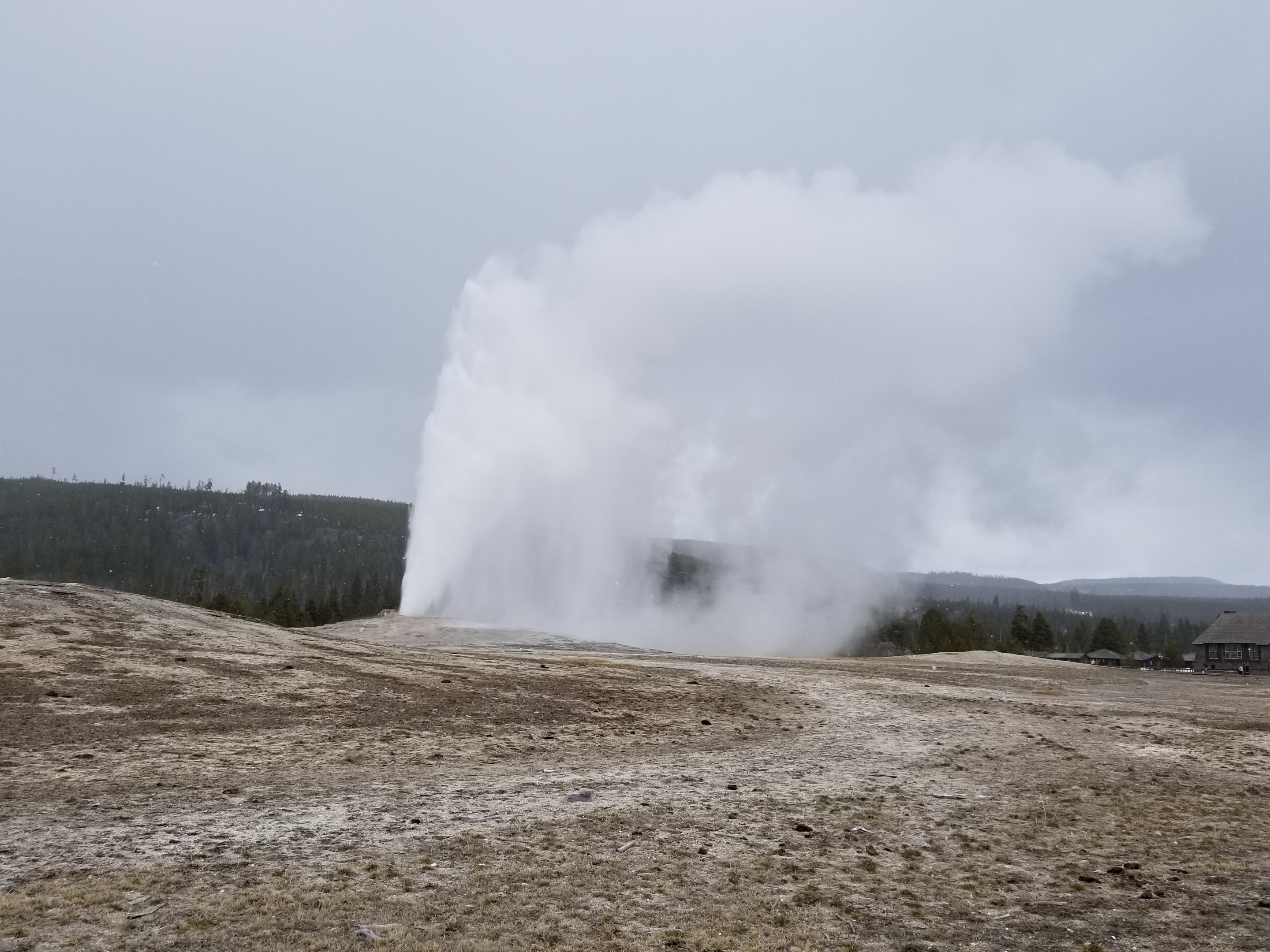
Yellowstone.



Little Bighorn Battlefield.


Devil's Tower.


Mount Rushmore.


Yellowstone.
Little Bighorn Battlefield.
Devil's Tower.
Mount Rushmore.

My friends Joaquin, Kenandra, Luis, Phil, Steve, Tracy, and I played through the classic D&D adventure The Keep on the Borderlands using the 1981 D&D Basic Rulebook. The Keep is a long adventure, and we got a good look at early D&D and how it differs from modern versions like the current 5th edition.
Thanks to our Dungeon Master Steve for running this!

Here's the 1981 Basic Rulebook, by Gary Gygax, Dave Arneson, and editor Tom Moldvay. Erol Otus drew the cover art and a few of the interior illustrations.


Although it's an early version, Basic already includes D&D trademarks like rolling 3d6 for your six attributes, Magic Missile, owl bears, gelatinous cubes, and others. But the game is most interesting because some D&D staples there are still weirdly unpolished.
For instance, dwarf, elf, and halfling are classes along with cleric or fighter, not races. So there's no such thing as a dwarf fighter, since those are mutually exclusive classes. Alignments are lawful, neutral, or chaotic, but good and evil aren't alignments yet, and the book notes that lawful is usually good and chaotic is usually evil. So, alignments can't yet describe a chaotic good Robin Hood or a lawful evil Sheriff of Nottingham.
Similarly, you seem to earn alarmingly little experience each game, until you realize that each gold piece worth of treasure you take also gives you an experience point. Basic has saving throws, but they're weirdly specific like saves against “Poison or Death Ray.”
Combat is minimal compared to modern D&D. Typically you just move and attack, by rolling a d20 to hit and a d6 for damage, or maybe use a spell or magic item. Characters don't have the big arsenal of class features that D&D 5e has, or bonus actions or reactions to fill out your turn.
On the other hand, Basic does have an unusual structure around combat, the ten minute turn. A turn is the time to do everything in one dungeon room - enter, fight, heal, loot, etc. A turn has a lot going on - check for wandering monsters, enter a room, roll the distance to monsters, roll to see if each side is surprised, roll the monsters' reaction to seeing the party, etc. But, we didn't actually use turns in our games.
Of course, the verbal roleplaying component in Basic is the same as a modern game, and I think Basic would be most fun with gregarious players in a roleplaying-heavy adventure, like an investigation requiring a lot of social interaction with the NPCs.
THE KEEP ON THE BORDERLANDS
The Keep on the Borderlands (1979) is an early adventure by Gary Gygax. The Keep was included in D&D boxed sets and was "the most printed D&D module of all time."
The adventure has two main components, the eponymous Keep and the Caves of Chaos, which the adventure describes as:
"...atop a sheer-walled mount of stone, looms the great KEEP. Here, at one of civilization's bulwarks between good lands and bad, you will base yourselves and equip for forays against the wicked monsters who lurk beyond. Somewhere nearby, amidst the dark forests an tangled fens, are the Caves of Chaos where fell creatures lie in wait."
The Keep is essentially a small town, with an inn, tavern, temple, and shops including a provisioner and trader, among other things. Besides getting rest and supplies, the party can also hear rumors there helping guide their forays outside. The Keep surprised me a little, because I didn't expect such an early module to include a town that the party could nonlinearly explore and revisit at will.
I won't give away too much about the Caves, except that their unlikely assembly of angry monsters is classic retro dungeon crawl, punctuated with some alarming surprises. Besides the Caves themselves, the wilderness around the Keep also includes a few small challenges to get the party warmed up.
Gygax explicitly leaves many details to the Dungeon Master, presenting the Keep as a starting point for the DM's own worldbuilding, and our DM Steve added a lot of his own elements to the story. For example, the book doesn't name NPCs or their shops, but we soon met Jovann at the Leaping Wolf Inn, Emodius the provisioner at the Wandering Spirit, and others. Gygax didn't include a magic shop, but we soon met Bernard Theobold at the Cackling Kettle. Bernard couldn't supply us with potions without "moon rocks" from the Caves, so we soon cleared some of the caves and installed our own miners there. Steve also added competing parties working out of the Keep, and a board at the tavern for betting on the parties' survival, which we used to bootstrap our bank accounts by betting on ourselves.
We played the adventure out of Goodman Games's recent "Into the Borderlands" book, which includes reprints of the original adventure, a 5e conversion, and essays by Mike Mearls and others.

The Keep on the Borderlands is also available on DriveThruRPG, and their page includes some interesting history of the adventure by Shannon Appelcline.
Silicon Valley sits between San Francisco to the north and San Jose to the south, and a lot of big tech companies are there. I worked there for fifteen years, at Google, Facebook, and Magic Leap.
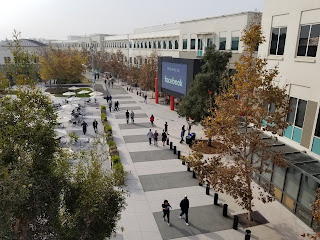
I worked at Facebook (now Meta) in Menlo Park, on the Classic Campus. The Classic Campus was originally the Sun Microsystems campus, and the back of the Meta sign there is still the Sun sign. Sun built Unix workstations and created Java; Oracle bought them in 2010.


The Classic Campus courtyard.
Facebook's newer buildings nearby were designed by Frank Gehry. Here's my old friend James visiting.

A tribute to Alan Turing inside the new buildings.

Stanford University is in Palo Alto. A lot of Silicon Valley's tech companies originated at Stanford, like Hewlett-Packard, Sun, SRI, SGI, Google, and Yahoo. The most prominent landmarks on the campus are the Hoover Tower and Memorial Church.


The infamous Stanford prison experiment was conducted there, in Jordan Hall. I like the undergraduate Stanford Shakespeare Company.
University Avenue nearby, posh dining and shopping.

I worked at the Googleplex in Mountain View for ten years. Buildings 40-43 were the heart of the campus then, and they were originally the SGI campus; SGI's Unix workstations dominated high-end graphics before PCs became credible graphics engines in the late 1990's.

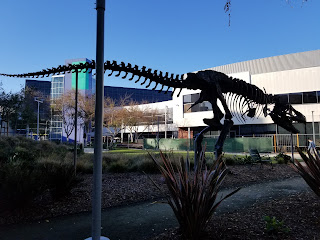
The Tyrannosaurus at the Building 43 entrance.
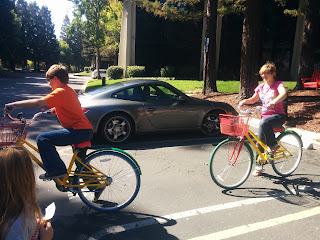
The famous Googleplex campus bikes, and my sister's kids trying them.

The Computer History Museum is a few blocks south of Google.

NASA Ames is just east of Google. Its giant Hangars One, Two, and Three were originally built to house blimps and are conspicuous from US 101. Here's a U2 spy plane on display outside Hangar One.

I worked at Magic Leap (the AR company) in Sunnyvale for two years. A hawk had a nest on one of our window ledges when I worked there; here's a different (I think) hawk near the entrance.
Many of the buildings surrounding Magic Leap were the Atari campus back in the day. Atari had two world headquarters there - one for the Atari 8 bit period and one for the Atari ST period - but they've been torn down just in the last few years.

Apple is in Cupertino. 1 Infinite Loop is Apple's longtime headquarters.

I was a tourist in Washington, D.C. for a few days in February. I last visited in 1998 with my old friend John.
The Capitol building, Washington Monument and World War II Memorial, and the Lincoln Memorial. My friend Buck suggested shooting the monuments at night.


The Martin Luther King, Jr. Memorial is on the Tidal Basin, across from the Jefferson Memorial.

The Eisenhower Memorial is near the Air and Space Museum. The MLK and Eisenhower memorials are both new since I last visited.

I went to the National Museum of American History, on the mall. Hank Aaron in his Milwaukee Braves gear.

The museum had a nice section on Silicon Valley, which was kind of a miniature Computer History Museum. Among other things, they had a Xerox Alto and an Altair 8800.


The National Gallery of Art was the high point for me, lots of great stuff there. This picture is Degas's "Little Dancer Aged Fourteen." I like Waldemar Januszczak's Perspective art documentaries, and he discusses this piece at length here (at 28:29).

I went to the National Archives to see the Constitution and the Declaration of Independence. I was surprised that they also had an original (of the 1297 version of the) Magna Carta. Pictures aren't allowed inside the building but here are some kids skating outside it.

Ford's Theatre.

Arlington Cemetery.

Here's an old picture of John walking next to the reflecting pool, from our 1998 visit.

With COVID and retirement, I've had more time to take care of myself and learn some cooking. Most of my cooking experiments have been American comfort food, June Cleaver type stuff.
Slow cooker chicken sausage gumbo. I think this was Crock Pot Chicken, Sausage, and Shrimp without the shrimp.
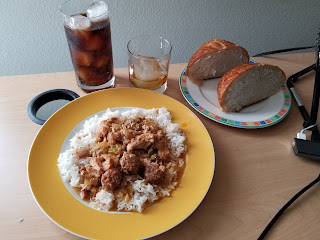
I like the slow cooker - you cut stuff up in the morning and put it in, then clean up and putter around all day while the smell fills the house. The slow cooker's also good for pulled pork sandwiches, spare ribs, chicken burritos.
Spicy chicken stew. I've made this one a lot, it's like hearty lumberjack food and another slow cooker recipe.


Now I lean toward curly noodle chicken soup though.

Blueberry pie and whiskey.

Chicken pot pie. The recipe suggests a store crust but I make it with the same double crust from the blueberry pie.


Roasted sausage and potatoes. It's easy - mix the stuff together, bake at 450 for 20 minutes, then at 500 for 20 more minutes, mixing occassionally. Perfect with scrambled eggs or an omelette.

Creamy ham and potato soup. One surprising thing I learned here is, there's such a thing as too much ham. Don't double the ham.

Ham bone soup. This one photographed well, but the taste was disappointing. I made a ham and bean soup like this one that was better, the flavor and the texture from the beans get into the broth.
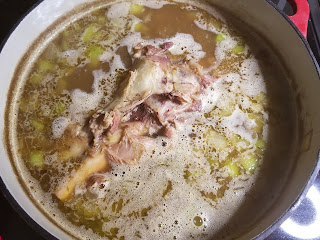

Coming up I want to do more soups - corn chowder, seafood chowder, wedding soup, better chicken stews - and good homemade breads and hot sandwiches to go with them. I also want to learn some Indian cooking and pho.