I mentioned in an earlier post that
the Atari 2600, the Apple II, and TI-99/4A are what got me into computers in the 80’s.
Of those three, the Apple II had the biggest impact by far, and I did most of my programming on the Apple II
until switching
to an Atari 520ST in 1986 or so. Over the last few years I’ve had a couple of Apple II’s in my closet waiting
for me to clear my schedule, and I’ve been able to dust them off in the last few weeks and fire up the original
Wizardry, which I never played in the day.
I think it’s safe to say the Apple II was the granddaddy of the home computer era, the late 70’s and 80’s,
before the personal computer market narrowed to Windows PC’s and the Macintosh. Apple launched the
Apple II as its first product in 1977 and manufactured them until the IIe ceased production in 1993, long after
they were technically obsolete. In contrast to the Commodore 64, the other monster seller of the time, the
Apple II was pervasive in schools, which was a major reason for its dominance.
My first picture shows the Apple IIe, while the second shows the IIc, on loan from a friend.
The IIe used a 6502 processor running at 1 MHz and had 64 KB of RAM. The IIc used a 65C02, again running at 1
MHz, and had 128 KB of RAM.
They featured a 40x24 text mode, a 40x48 Lo-Res graphics mode with 16 colors, and a 280x192 Hi-Res graphics mode
with 6 colors.
They included a BASIC interpreter in ROM, which was used for both programming and as the machine’s command line
interface.


By modern standards the IIe feels overly solid or even MIL-SPEC, and I overheard my cleaning person moan as she
lifted it
off the floor, surprised by the weight. The keyboard is super solid, and I’m not surprised that it still works
perfectly
after 25 years or more. The Apple II disk drive makes characteristic grinding and shuddering noises that
sound dangerously broken until you get used to them.
The original Wizardry, “Proving Grounds of the Mad Overlord,” was developed by Andrew Greenberg and Robert
Woodhead
and was one of the most popular games on the Apple II and other machines. As far as I can tell it’s the
first
great computer RPG, and in his interview with Matt
Barton,
Woodhead explains how he derived the game and its unforgiving difficulty from pen and paper Dungeons and
Dragons rather than a previous computer game.
I got my copy from EBay. The box included a receipt showing that it was originally purchased in Lafayette,
Indiana in 1983. :)
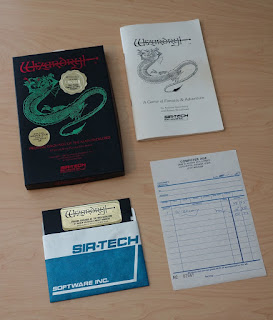
Here’s the splash screen. It alternates with a message warning you to “PREPARE YOURSELF FOR THE ULTIMATE IN
FANTASY GAMES.”

Wizardry saves the player’s progress on the game disk, so when I loaded the game I was treated to a time capsule
of the original owner’s characters. I found some of the expected Tolkien names like GANDALF, BILBO, and THORIN,
but also a few other 80s-fantasy-nerd-approved names like ALANON and COVENANT. Given the original owner’s time
and town,
I imagine "FRIDGE" must be the Chicago Bears' Refrigerator, William Perry.

At a high level, the game is similar to many other CRPG’s: your 6 adventurers fight their way through
10 levels of an underground maze to retake an amulet from the evil wizard Werdna.
My screenshots show a typical exploration screen, which shows the maze in 3D, and a typical monster
encounter screen, which shows a simple graphic representing the monsters. Both screenshots show my
6-member party at the bottom.


Each maze level consists of 20x20 squares. Unlike Tunnels of Doom, which came out for the TI just a year
later, there’s no automapping, so you have to map the levels yourself on graph paper and keep track
of the party’s position and facing carefully. (Actually, the maze is hardcoded rather than randomly
generated, so accurate maps are available online, and I’ve relied on a mix of my own maps and
online maps.) The picture is a scan of my own map of the first maze level, annotated with some of
my positions at different times and places where I found keys.

Despite the boilerplate plot, the game has a lot of character and is *unforgivingly difficult*.
In the Matt Barton interview, Woodhead comments on the difficulty, saying "...I know that back in the
old days, gamers were real gamers, and they weren’t pussies like the kids are today."
For instance, the game is designed to prevent you from restoring from a previous save point if
your party is killed, so you have to be overly conservative in levelling your characters
before tackling each new challenge. The layout of the maze levels and traps can be
dense like a Bach concerto, far exceeding what I expected from an early 80’s game.
At the rough halfway point of the game, the party has a harrowing fight in a "Monster Allocation Center" on level
4,
which earns them a blue ribbon that allows easy elevator access to any floor in the maze. With the blue ribbon
in
hand, the game appears to be a matter of levelling and arming yourself with special items from the maze
until you’re prepared to tackle Werdna.
I haven’t finished the game yet but I’ve made good progress. Most of my characters have reached level 11, and
I’ve
beaten the Monster Allocation Center and claimed the blue ribbon. Priests and mages start to get their
highest level spells at level 13, and I imagine they’ll randomly gain them all by level 14 or 15.
So, I still have some leveling to go before seeking out Werdna.
Here are a few screenshots documenting my fight in the Monster Allocation Center, which is protected by a
fixed (non-randomized) party including fighters, mages, high priests, and a “high ninja.”
At this level, mages have multiple nuclear options. So for either side, the key is for your
mages to avoid being silenced by the opposing priests and then kill the opposing mages ASAP.
In the event, my priest RACKHAM was luckily able to silence the opposing priests, preventing
them from silencing my mages BARDOLPH and GLENDOWER, and BARDOLPH then killed the opposing
mages and fighters in the first round. My fighters BLACKMOOR and GUILDER also killed the
ninja in the first round, but the silenced priests survived into the second round.


The opposing mages did do alarming damage in their half round of life, which you can see in the second
screenshot, so things easily could have gone the other way. :)